
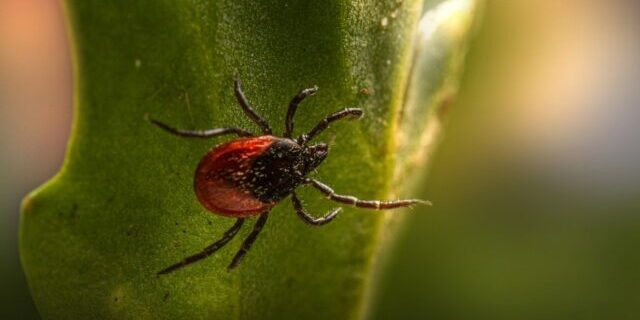
Ticks are small external parasites belonging to the subclass Acari of the class Arachnida, close to spiders.
Ticks are a health risk for dogs, cats, horses, and humans: their bites can transmit diseases and often go unnoticed.
Around 900 different species of ticks are recorded worldwide.
The suborder Ixodida (ticks) comprises three families:
- the Ixodidae with 14 genera (hard ticks),
- the Argasidae with 4 genera (soft ticks),
- the Nuttalliellidae, represented by a single species.
Hard ticks, as their name suggests, have a hard chitinous «shield». (the scutum) on their backs, which depending on the stage of development either covers only a part or the whole back, whereas soft ticks have a leathery skin without a dorsal scutum.
In Europe and North Africa, the most represented genres are:
- Ixodes (25 species),
- Hyalomma (11 species),
- Haemaphysalis and Rhipicephalus (8 species each),
- Ornithodoros (7 species),
- Argas (6 species),
- Dermacentor (2 species).
The main tick species of importance in Switzerland are: Ixodes ricinus and others Ixodes spp.., Dermacentor Reticulatus, Rhipicephalus sanguine, Hyalomma marginatum.)
The species Ixodes ricinus is by far the most common type of tick in all of Central Europe. This tick is found in a wide geographical area stretching from Portugal to Russia and from North Africa to Scandinavia. The primary habitats of’Ixodes castor are found in rural areas, in deciduous and mixed forests, at forest edges or in gardens. However, the tick is also present in urban areas such as cemeteries, parks, outdoor swimming pools and others. In Switzerland and neighbouring countries, the presence of’Ixodes ricinus has been observed up to an altitude of approximately 1,500m.
The development cycle from the tick Ixodes ricinus consists of 3 stages:
- Larvae hatched from eggs,
- Nymphs,
- Adult males or females.
A blood meal taken from a host animal allows the tick to develop. The tick's life cycle generally lasts three years (around one year for each stage). However, depending on climate conditions and geographical location, a tick's development can vary from two to six years.
The optimal temperature for tick activity is between 14°C and 23°C with a Relative humidity air of at least 80%. Ticks do become active as soon as the average ground temperature exceeds 7°C for 5 days. Climate change contributes to the increase in tick populations by extending their activity season and their survival in winter.
In general, Ixodes ricinus Set out an activity diagram in two periods, with higher activity in spring and autumn, but this can vary from year to year in a given habitat. In Switzerland, the season during which ticks are particularly active begins in March and ends in November., depending on the weather conditions.
In favourable weather conditions, ticks can be found on vegetation close to the ground, up to about one metre (nymphs) or one and a half metres (adults) high, and will drop onto a passing host. To orient themselves, ticks use Haller's organ, which is located on the tarsus, the last segment of the first pair of legs. The receptors of the organ of Haller allow the perception of mechanical stimuli (vibrations), chemical (odours, carbon dioxide) and thermal (body heat).
Besides Haller's organ, ticks possess a series of other sensory hairs located on the palps, on the sides of the mouthparts, and on the two pairs of front legs. Once a host is found, the tick begins to search for a suitable site to suck blood. This search can take several hours. During the subsequent blood meal, the tick alternately releases saliva into the forming haematoma and absorbs blood, tissue fluids, and cellular substrate. Saliva contains a large number of proteins and anaesthetic lipids, anticoagulants, tissue solubilisers, and immunomodulators, which suppress the host's ability to sense the tick. The act of sucking lasts between two days for the larvae and 13 days for the females. The tick can then absorb 100 to 200 times its own weight in blood. Carried by the host animal until its detachment, this allows it to reach other habitats in which it can continue to develop and reproduce.
Environment 10 % from some 900 species of ticks known to date are important for veterinary or human medicine due to their ability to transmit pathogens (vector competence). Aside from the direct consequences of blood ingestion and, in some cases, the secretion of toxins in tick saliva, the main problem with ticks stems from the wide variety of pathogens they can transmit, including bacteria, viruses, single-celled parasites (protozoa), and parasitic worms (helminths).
Certain species of tick parasitize dogs, cats, horses, and humans, creating a continuum of risk between animal and human health.
The main diseases that can be transmitted to dogs and cats through tick bites are:
- LLyme disease (borreliosis),
- Lbabesiosis (piroplasmosis)
- Ehrlichiosis (similar to anaplasmosis)
- Tick-borne encephalitis (TBE)
- Rocky Mountain spotted fever
- Tularemia
In summary, different pathogens are transmitted by different tick species to different animals and to humans, hence the importance of to protect yourself against these small pests.
Sources and references:
- Swissticks.ch
- Agustín Estrada-Peña, Andrei Daniela Mihalca, Trevor N. Petney Editors. Ticks of Europe and North Africa – A Guide to Species Identification. Springer International Publishing AG 2017
- Gray, J.S. The development and seasonal activity of the tick Ixodes ricinus: a vector of Lyme borreliosis. Rev Med Entomol, 1991 79:pp. 323-333
- Ehrmann, S., Liira, J., Gärtner, S. et al. Environmental drivers of Ixodes ricinus abundance in forest fragments of rural European landscapes. BMC Ecol 17, 31 (2017).
- De la Fuente J et al. Tick-Pathogen Interactions and Vector Competence: Identification of Molecular Drivers for Tick-Borne Diseases. Front Cell Infect Microbiol. 2017 Apr 7;7:114.
- Dobler G. et al, The TBE Book, 4th Edition, Global Health Press 2021
- Pages F, Dautel H, Duvallet G, Kahl O, de Gentile L, Boulanger N. Tick repellents for human use: prevention of tick bites and tick-borne diseases. Vector Borne Zoonotic Dis. 2014 Feb;14(2):85-93.
- Epidemiological Bulletin Robert Koch Institute, February 2019/No. 7
- European Centre for Disease Prevention and Control; Ixodes ricinus – Factsheet for experts
- Federal Office of Public Health FOPH
- https://www.zecken.de